Career Development
Career Planning Resources
Explore Careers
There are many avenues to explore careers. XELLO Identifies what your potential career interests include. College and Careers includes numerous resources to check out valuable college and career related information.
Create your EDP
What is an Educational Development Plan (EDP)?
An Educational Development Plan (EDP) is a very useful tool to assist students with their career preparation process. It provides a place to record results of assessments, career research, reflections on exploration activities, etc., and to correlate this growing body of information with a plan of action to achieve educational and career goals.
Students need answers to important questions: Who am I? Where am I going? How do I get there? By being involved in career preparation and in creating their EDPs, students can become engaged in a process that assists them in exploring and examining their interests, skills, and abilities and in beginning to make decisions about selecting a career path for the future.
Ongoing career development helps students to become involved in learning a process that will prepare them for the choices and decisions they need to make regarding careers and setting goals. In schools, this process includes participation in career pathways, career awareness and exploration, assessment and guidance, and integrated learning (which combines academic and career-related content and is presented in coordinated learning activities.) An EDP, whether on paper or electronic, provides an ongoing record of career and educational decisions and guides the learner in accomplishing goals based on an informed plan of action. Setting goals and recording them in an EDP helps students become more intentional about being successful in their classes and in selecting extracurricular and employment activities. To be effective, EDPs do not stand alone. They are dependent upon participation in the larger, ongoing career development process and they should be reviewed and updated annually.
Essential EDP Elements
- Personal Data / typically includes name, address, birth date, and grade level
- Career Goal(s) / Young students choose interest areas by listing career pathways in order of preference. Older students who have had opportunities to refine their choices over time should be asked to become more specific about occupations, stating both desired career pathway(s) and related job titles.
- Education/Training Goals / long-range goals regarding the formal education or preparation needed, (i.e. apprenticeship, certificate program, 2 or 4-year degree program, military, etc.)
- Career Assessment Highlights / Learners need opportunities to use the results of formal assessments and informal observations to assist in choosing career goals. Watching for consistency of career assessment results over time, the learner will be aided in confirming career decisions.
- Career Awareness, Exploration, & Work-Based Experiences / listing of activities that he/she has and intends to participate in order to gain a better understanding of career options and characteristics, (i.e. researching career information, volunteer/community service, job shadowing, internship, CTE program, internship, part-time employment, etc.)
- Course Selection / (required and elective) a sequential plan of courses that provide academic and career-related preparation relevant to goals and continuing education
- Parent Consultation/Endorsement / Parents of middle and high school students should have the opportunity to review and endorse their child's EDP.
- Student Portfolio / a place to document acquired skills and showcase selected meaningful material.
Career Cruising (www.careercruising.com) is an amazing internet-based career resource and EDP tool, which Chippewa Valley Schools subscribes to for all of our middle and high schools. Each school has its own unique password. Our license agreement allows students, parents, and staff to utilize this resource from home as well as school. To learn your school's password, please contact your guidance counselor.
To access an explanation of the Chippewa Valley Schools' Career Cruising Program, please click here.
Or
Chippewa Valley Schools Job Shadowing
 "Who knows what wonders lurk in the hearts of students? The shadowers do!"
Job Shadowing is designed to give students an opportunity to "shadow" an adult during daily work activities. It inspires students to be enthusiastic about their studies by showing them the correlation between what they learn in school and how it is used in the workplace. In 2008, more than one million young people and 100,000 businesses participated.
Beginning with a nationwide kickoff on February 2 annually (Groundhog Day) and continuing throughout the school year, Job Shadow is supported by a coalition that includes America's Promise, Junior Achievement, AT&T, the U.S. Department of Education and the U.S. Department of Labor. For more information, log on to www.jobshadow.org.
The Michigan Department of Education now mandates a "work-based learning experience" for all CTE (Career Tech Ed) students. Job Shadowing satisfies that requirement.
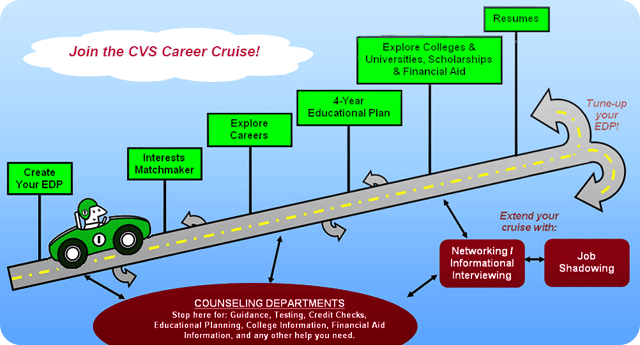
Chippewa Valley Schools have an excellent career development program, designed to help students create an EDP (Educational Development Plan). The program uses "Career Cruising" and leads students to:
- discover/explore their interests,
- assess skills
- explore career information
- develop a 4-Year Plan
- identify some goals
- do a school / college search
- select some career development activities for further exploration
- create a portfolio of experiences and accomplishments
While this is an outstanding career development program, there is need to do more. Job Shadowing can fill the gaps. Job Shadowing offers the opportunity to reality-test career interests. Two students who recently job shadowed reported to their classmates: 1) "I thought I wanted to be a commercial artist, and after spending the day with Mrs. G, I know that I want to be a commercial artist!" and 2) "I was thinking about a career in business or Dentistry. I job shadowed a dentist and... Now I know that I don't want to be a dentist!" Reality testing can be empowering and valuable in terms of both time and money.
It has been reported that 80 to 85% of all jobs are found and filled through personal contact. It is also said that you can reach anyone in the world by going through only six people. Networking is an effective strategy for gathering current career information, developing mentor relationships, and for ultimately finding avenues into desirable careers. Most of us have been helped by others along our career paths. Career holders are most often very willing to help aspiring students. It is a "pay it forward" matter.
It is now predicted that today's high school students will have 8 jobs by the time that they reach age 35. Chippewa Valley students will be prepared for this future by mastering the "Career Cruising" activities, and by doing the original research that involves networking, informational interviewing, and job shadowing.
It is our goal to help students to have a focus and a plan, and to prepare for their futures. Job Shadowing is an important component of our comprehensive career development program. Please see your school's "Job-Shadowing Policy and Guidelines" and "Job Shadow Application" forms for specifications. After reviewing these materials, feel free to contact us (administrators, counselors, CTE staff) if you have any questions.
The CTE brand logo, brand positioning theme and brand extensions are the property of NASDCTEc.
The following Job-Shadowing materials (links) are designed to guide students through a Job-Shadowing experience:
- Chippewa Valley Schools District Field Trip Procedures
- Chippewa Valley Schools Job Shadowing Introduction
- Chippewa Valley High School (CVHS) Job-Shadow Guidelines
- Chippewa Valley High School (CVHS) Job-Shadow Application
- Dakota High School (DHS) Job-Shadow Guidelines
- Dakota High School (DHS) Job-Shadow Application
- Informational Interviewing
- Job-Shadowing Student Report
- Sample Thank You Letter
Join the CVS Career Cruise!